What “Entitlement” Actually Means
Most owners and developers use the word “entitlement” loosely, often as shorthand for “getting approvals.” That’s not wrong, but it understates how much is actually happening. Entitlement is the full process of converting a piece of land from what it is today into what you have the legal right to build on it. It ends when you have permits in hand and a shovel can legally go in the ground.
In Western New York, that process involves multiple government agencies, a team of specialized consultants, a series of public hearings, and a set of decisions that only the owner can make. It is not a straight line. It runs on overlapping tracks, some sequential and some concurrent, and the difference between a project that moves efficiently and one that bogs down often comes down to whether the right people were assembled at the right time and whether everyone understood their role.
This article walks through the entitlement process from start to finish: what happens at each stage, who is responsible for what, and where the opportunities for smart collaboration exist.
This article focuses on commercial and industrial site development in Monroe, Wayne, Ontario, Genesee, and the surrounding Finger Lakes counties. While the fundamental structure of entitlement is consistent across New York State, timelines, agency requirements, and local practices vary by municipality. What follows reflects the landscape we navigate every day in this region.
It Takes a Team. Here Is Who Is on It.
One of the most common mistakes owners make early in the process is assembling their team too slowly, or in the wrong sequence. Each consultant brings a specific kind of expertise, and each has a natural entry and exit point in the timeline. Bringing someone in too late costs time and money. Bringing someone in too early, before the data they need exists, is equally wasteful.
Below is the core entitlement team for a typical commercial or industrial development in Western New York, with an honest description of each role and when they belong in the process.
| Stakeholder | Role in Entitlement | Enters the Process |
|---|---|---|
| Owner / Developer | Sets vision, controls budget, makes all binding decisions, signs applications, attends key hearings. The project exists because of this person. Every other team member serves their goals. | Day One |
| Civil Engineer + Land Surveyor | Establishes site conditions through survey, leads site design, manages agency submissions, navigates SEQRA, attends planning board and ZBA hearings. The technical spine of the approval process. | Day One |
| Attorney | Reviews title, advises on zoning interpretations, represents the owner in variance hearings, drafts easements and covenants, advises on development agreements. Critical when the project involves a rezoning or contested approval. | Early / As Needed |
| Architect | Designs the building program and exterior, coordinates with civil engineer on site layout, prepares building permit drawings after site plan approval. Building design cannot be finalized until the site can support it. | After Site Feasibility |
| Environmental Consultant | Performs Phase I and Phase II Environmental Site Assessments, delineates wetlands, prepares environmental studies required by SEQRA or NYSDEC. Required whenever contamination, wetlands, or significant environmental review is possible. | Due Diligence Phase |
| Traffic Engineer | Conducts traffic impact studies when required by the municipality or NYSDOT. Analyzes site access, turn lanes, signal warrants, and Level of Service. Often triggered by project size or proximity to a state or county road. | Preliminary Design Phase |
| Real Estate Broker / Appraiser | Advises on land acquisition, comparable sales, and market conditions. Appraisers are often required by lenders. Brokers help structure purchase agreements with appropriate contingencies tied to entitlement milestones. | Pre-Acquisition |
| Lender / Financial Advisor | Structures financing, requires certain due diligence deliverables as conditions of commitment, and sets the financial timeline the entitlement process must align with. Their requirements shape the entire project schedule. | Pre-Acquisition |
| General Contractor | Provides constructability input and preliminary cost estimates during design, then executes construction once approvals are in hand. Early contractor involvement improves budget accuracy and reduces re-design after approval. | Preliminary Design or Later |
| Municipal Agencies | The Planning Board, Zoning Board of Appeals, Building Department, and other local bodies that review, condition, and ultimately approve the project. They are not adversaries. They are stakeholders whose concerns must be understood and addressed. | Pre-Application Through Permit |
| State and County Agencies | NYSDEC, NYSDOT, Monroe County DOT, FEMA, and others who have jurisdiction over specific aspects of the project. Their reviews run concurrently with local approvals wherever possible. | As Triggered by Project Scope |
The civil engineer sits at the intersection of almost every other team member's work. Survey data feeds the site design. The site design constrains the architectural program. The site layout triggers agency reviews. The agency comments drive design revisions. Keeping this chain moving without bottlenecks is a primary function of the civil engineering role in entitlement.
Soup to Nuts: The Eight Stages of Entitlement
The entitlement process in Western New York does not run as a single sequence. Several stages overlap, and smart project management means running parallel tracks wherever possible. What follows is the logical order of decision-making, with notes on where concurrent work can compress the overall timeline.
- Preliminary zoning review and use analysis
- Utility availability assessment
- Identification of environmental constraints
- Preliminary site feasibility opinion
- Purchase agreement with entitlement contingency
- Budget and timeline parameters
- Go / no-go decision on the site
- Engagement of attorney and broker
- Real estate attorney: title review
- Environmental consultant: Phase I ESA
- Broker: purchase structure and terms
- Full boundary survey establishing legal parcel limits
- Topographic survey capturing existing grades and features
- Location of utilities, structures, and easements
- Production of base map used by all downstream consultants
- Authorization to proceed onto the property
- Access coordination with sellers if pre-closing
- Architect: receives base map to begin massing studies
- Environmental consultant: uses survey for wetland delineation
- Concept site plan layouts exploring access, parking, and building placement
- Identification of all required approvals and submitting agencies
- SEQRA classification assessment
- Preliminary stormwater and utility routing
- Opinion of probable site construction cost
- Selection of preferred design concept
- Budget confirmation and risk tolerance decisions
- Alignment with lender requirements
- Architect: building footprint and program input
- Traffic engineer: initial scoping if triggered
- Contractor: early cost feedback if engaged
- Presentation of preliminary concept to planning board
- Collection of board feedback before design is finalized
- Identification of potential points of resistance
- Relationship-building with board members and staff
- Attendance is valuable and often impactful
- Decision to proceed based on board's initial posture
- Attorney: present if zoning interpretation is at issue
- Architect: may present building concept if useful
The pre-application meeting is the most underused tool in the entitlement process. Most applicants skip it to save time. In nearly every case, the boards and municipalities that see a project before a formal application is filed are the ones that move faster once it is.
- Full site plan drawing set: grading, drainage, utilities, geometry, landscaping
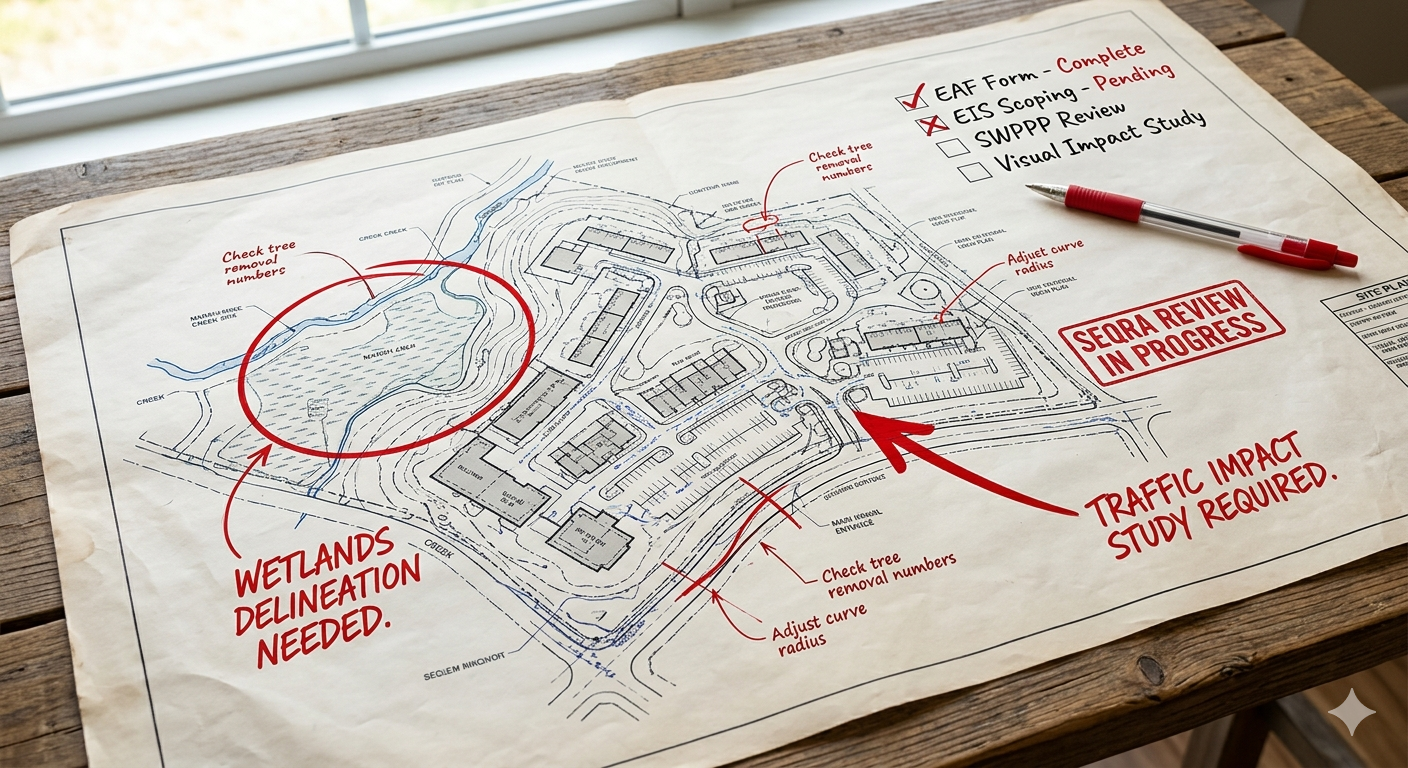
- Stormwater Pollution Prevention Plan (SWPPP) if required
- Subdivision plat or land division documents if applicable
- Coordination with architect, structural, and specialty engineers
- Application packages for all required agencies
- Approval of final site layout before submission
- Phasing strategy if project is staged
- Application signature and fee payment
- Architect: building permit drawings (concurrent)
- Traffic engineer: final study submission
- Environmental consultant: SEQRA supporting documents
- Simultaneous submission to all required agencies where possible
- Presentations at planning board and ZBA hearings
- Response to all agency comment letters
- Management of SEQRA review timeline and documentation
- Tracking of all deadlines and re-submission windows
- Authorization for any design modifications required by agencies
- Attendance at key hearings (recommended)
- Community or neighbor relations if applicable
- Attorney: variance hearings or contested proceedings
- Traffic engineer: responds to DOT comments
- Environmental consultant: SEQRA responses
- Coordination of building permit submission with approved site plan
- SWPPP notice of commencement filing with NYSDEC
- Pre-construction meeting support
- Contractor selection and contract execution
- Construction financing closing
- Insurance and bonding requirements
- Architect: building permit issuance
- Contractor: mobilization planning
- Lender: construction draw schedule
- Construction stakeout: building corners, road grades, utility lines
- SWPPP compliance monitoring
- As-built survey upon completion
- Certificate of occupancy support documentation
- Record document submission to applicable agencies
- Contractor coordination for stakeout scheduling
- Authorization for any field condition changes affecting approved plans
- Architect: building inspections and CO application
- Contractor: site construction and grading
The Variables: What We Navigate, What You Control
Every entitlement project carries variables — things that cannot be fully known at the outset and that require judgment calls along the way. Understanding which variables belong to which party, and being honest about that from the start, is what separates projects that run smoothly from those that create friction between owners and their consultants.
Variables MLA navigates on your behalf: Agency timelines and hearing cycles. The scope and duration of SEQRA review. The specific comments a planning board or reviewing agency will raise. The technical sufficiency standards of each agency. The sequencing of parallel submissions to compress the overall schedule. Code interpretations that require technical advocacy. Design modifications triggered by agency feedback.
Variables the owner must own: The project vision and program. The budget, including contingency for entitlement costs. The timeline expectations, including alignment with financing commitments. The decision to proceed at each stage gate. The choice of architect, contractor, and other team members. Community relationships, particularly in projects with high neighborhood visibility. The risk appetite for projects that require variances or rezonings.
The most common source of friction in entitlement is misaligned expectations about timeline. Owners who enter the process expecting a 90-day approval and encounter a 9-month SEQRA review feel blindsided, even when the extended timeline was a foreseeable risk. The solution is an honest feasibility conversation at the very beginning, before design dollars are spent, before purchase contracts close, and before lender commitments are structured around an unrealistic schedule.
Concurrent Tracks and Collaboration Opportunities
Entitlement does not have to be a strictly linear process. Several stages can and should run in parallel, and the projects that move fastest are typically those where the owner and their consultants are communicating proactively rather than reactively. Below are the highest-value opportunities for compressing timeline through smart sequencing.
Survey and Phase I ESA together. The boundary and topographic survey and the Phase I Environmental Site Assessment are often scheduled sequentially when they can run concurrently. Both are triggered by the same decision to investigate the site, and neither depends on the output of the other. Running them in parallel saves two to four weeks on most projects.
Architectural massing concurrent with civil preliminary design. The architect does not need a completed site plan to begin building massing and program studies. They need the survey base map. Getting the survey done early and sharing it with the architect immediately allows the building program and site layout to develop in dialogue rather than in sequence, which produces better outcomes and fewer costly revisions later.
State and county agency submissions concurrent with local review. NYSDOT access permits, Monroe County DOT driveway permits, and NYSDEC stormwater permits do not need to wait for local planning board approval. In most cases these submissions can be made simultaneously, running the review clocks in parallel rather than end-to-end. This alone can compress the overall schedule by two to four months on projects with state highway frontage.
Building permit drawings during agency review. The architect can begin preparing building permit drawings while the site plan is in planning board review. Approval of the site plan will require minor coordination updates, but the bulk of the building permit work is independent of the site plan process. Owners who wait until site plan approval is in hand before engaging their architect on permit drawings are adding months to their construction start date unnecessarily.
Contractor involvement during final design. Bringing a general contractor into the process during final design, rather than after approval, allows for real-time constructability feedback and more accurate cost estimates before the project is locked. This protects the owner from discovering post-approval that the approved design is significantly over budget.
The entitlement team is most effective when it functions as exactly that: a team. The owner sets the vision. The consultants each contribute their expertise. And everyone understands where their lane ends and the next person’s begins.
Where McMahon LaRue Fits In
We are a civil engineering and land surveying firm. That is our lane, and we stay in it deliberately. What we bring to the entitlement process is technical depth, regulatory knowledge, and the ability to translate both into language that planning boards, agency reviewers, and project owners can all work with.
We pick up the project at the earliest possible stage, typically at site selection, because the most valuable thing we do is tell you what a site can and cannot support before you commit to buying it. We carry the project through every technical and regulatory stage, managing all agency submissions, hearings, and correspondence, and we stay engaged through construction support and final closeout.
What we are not is a development manager who coordinates the full team, a legal representative, a financial advisor, or an architect. We work closely with all of those roles and we communicate proactively with every member of the project team. But we are one essential specialist among equals, and a project that treats any single consultant as the solution to every problem is a project headed for disappointment.
What we can tell you, based on 35 years of combined experience navigating approvals in Western New York, is that the projects that succeed are the ones where every team member was engaged at the right time, everyone understood their responsibility, and the owner stayed active and informed throughout. The entitlement process rewards preparation and punishes assumptions. We are here to make sure you go in with both eyes open.
Start with the Right Conversation
If you are evaluating a site, under contract on a property, or early in the planning stages of a commercial or industrial project in Western New York, the best investment you can make is an honest feasibility conversation before any significant dollars are committed. Not a design kickoff. Not a purchase closing. A conversation about what the site can support, what the approval process will actually involve, who needs to be on your team, and what a realistic timeline and budget look like.
That is exactly what we offer in our initial consultation. No obligation, and no agenda beyond making sure you understand what you are getting into before you are fully in it.
That clarity is what the rest of the process is built on.