What Is SEQRA and Why Does It Touch Every Project?
If you’ve ever been through a development approval process in New York State and found yourself wondering why things suddenly stalled, there’s a good chance SEQRA was involved. Why a simple request for more information turned into a months-long detour. Why a board that seemed supportive in January was still deliberating in October. It happens more often than most people expect.
The State Environmental Quality Review Act, known as SEQRA, is a New York State law that requires government agencies to evaluate the environmental impacts of any action they undertake, fund, or approve. On its face, that sounds reasonable, even responsible. In practice, it’s one of the most powerful procedural levers available to a planning board, zoning board, or municipality that wants to pump the brakes on a project.
SEQRA applies to virtually any discretionary approval, including site plan approvals, special use permits, subdivisions, variances, and rezonings. If a board has the authority to say yes or no to your project, SEQRA almost certainly applies. And once it applies, it gives that board an enormous amount of procedural flexibility to request more information, expand the scope of review, and extend their decision timeline, all under the banner of environmental due diligence.
Key Concept: SEQRA doesn’t just evaluate environmental harm in the traditional sense. Under its broad definition, “environment” includes traffic, noise, community character, aesthetics, fiscal impacts, and historic resources. That expansive scope means nearly any concern a board has can find a home in SEQRA review.
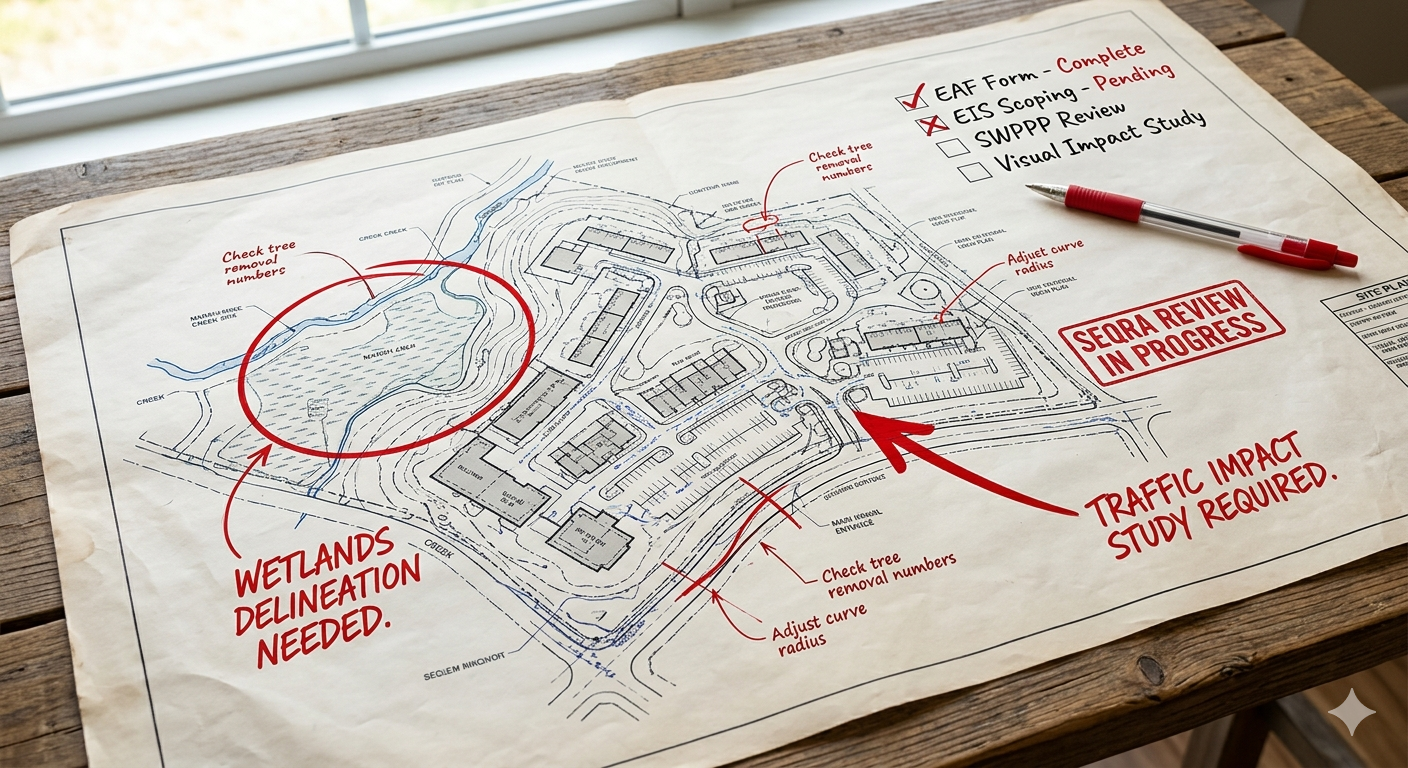
The process begins when a lead agency, typically the planning board, classifies your project as a Type I action, Type II action, or Unlisted action. Type II actions are exempt. Everything else triggers some level of review, ranging from a simple short-form Environmental Assessment Form (EAF) to a full Environmental Impact Statement (EIS), a document that can run hundreds of pages and take a year or more to complete.
”To Delay Is to Deny”
In theory, SEQRA is a tool for informed decision-making. In practice, it’s often something else entirely: a procedural mechanism for a board or municipality to slow a project they’re uncomfortable with, long enough that the applicant runs out of money, patience, or political will.
The classic pattern goes like this: A developer submits a well-prepared application. The board accepts it, opens the SEQRA review, and issues a request for additional information. The applicant responds. The board requests more. Meanwhile, months pass. Hearing cycles, which typically occur only once per month, each add weeks to the calendar. Consultants are retained to review submissions. Comment periods open. Neighboring municipalities must be notified. Each step is individually defensible, and collectively, they constitute a form of attrition.
“To delay is to deny.” It’s not a cynical observation. It’s a documented strategy that well-organized opposition groups and cautious municipalities use to exhaust applicants who lack the resources or expertise to stay the course.
And it’s not always cynical. Sometimes a board genuinely doesn’t understand a project and uses SEQRA’s information-gathering mechanisms to get comfortable. Sometimes a community has legitimate concerns that deserve careful consideration. The problem is that SEQRA treats good-faith uncertainty and bad-faith obstruction with the same procedural framework. Applicants bear the cost either way.
We’ve seen projects delayed 18 months waiting for a SEQRA determination that ultimately came back negative, meaning no significant environmental impact found. We’ve seen clients asked to study traffic conditions for intersections two miles from their project site. We’ve seen requests for noise studies on developments that don’t generate measurable noise. Each request, on its own, may have a colorable basis. Together, they constitute a game of attrition. The state has given municipalities all the tools they need to play it.
The question is: do you have a team that knows how to navigate it?
Why SEQRA Catches Projects, and Their Owners, Off Guard
Most property owners and developers approach a project with a reasonable assumption: if what they’re proposing is lawful, meets the zoning code, and addresses the board’s stated concerns, approval should follow. SEQRA disrupts that assumption entirely.
Under SEQRA, a lead agency cannot approve a project until it has completed environmental review. The agency, not the applicant, controls the pace and scope of that review. This means requests for studies, surveys, and supplemental analyses that were never part of the original scope of work can arrive at any point in the process. Engineers are asked to model stormwater impacts that weren’t contemplated in the original design contract. Traffic engineers are brought in mid-stream. Wetland delineations are requested on parcels that were never thought to have wetland issues.
Beyond the direct cost of responding to these requests, there’s the opportunity cost of time: construction seasons missed, financing terms that expire, market windows that close. For many applicants, especially smaller developers, landowners, or businesses trying to expand a facility, a 12- or 18-month delay isn’t an inconvenience. It’s a project-killer. And that’s exactly what some municipalities are counting on.
What This Means for Your Budget and Timeline: SEQRA-related delays are one of the leading causes of cost overruns on development projects in New York State. Studies, consultant fees, re-design costs, and extended carrying charges add up quickly. Projects that aren’t structured to anticipate and absorb this process often don’t survive it. Understanding this reality before you start, not after you’re in it, is the single most important thing a project team can do.
Turning the Process into a Strategic Advantage
We’ve been through this process more times than we can count, and what we’ve learned is that the firms and applicants who succeed aren’t the ones who fight SEQRA. They’re the ones who understand it deeply enough to get ahead of it.
Our six-phase approach was built, in part, around the realities of the New York approval environment. It’s structured to front-load the information that agencies will eventually ask for, present it in a format that disarms rather than antagonizes, and position every stakeholder, including the board, the community, the neighbors, and the reviewing agencies, as participants in a project that is a net positive for everyone involved.
That last point matters more than most people realize. Boards that feel like adversaries become adversaries. Boards that feel like collaborators become collaborators. The way you show up at a hearing, the quality of your materials, the confidence of your presentation, the degree to which you’ve already anticipated their questions. All of it shapes how the board perceives the entire project. We’ve walked into rooms where a project had real opposition and walked out with unanimous approval, because we came prepared for the conversation the board actually needed to have, not the one our client assumed they’d have.
We don’t just prepare engineering drawings. We prepare the entire case (technical, regulatory, and narrative) so that when a board member asks a hard question, we already have the answer.
Our principals bring both technical depth and what we’d call C-suite presentation skills to every hearing room. That combination, the credibility of licensed engineers and surveyors paired with the ability to translate complex regulatory and site engineering concepts into plain language, is genuinely rare. It’s what allows us to meet a planning board where they are, rather than expecting them to meet us where we are.
Six Phases. One Team. No Surprises.
Our project pathway was designed specifically to navigate the realities of New York’s regulatory environment, including SEQRA. Each phase has defined deliverables, clear decision points, and a deliberate purpose in the overall approval strategy.
-
Boundary & Topographic Survey: Before any design or regulatory strategy can begin, we establish the legal and physical conditions of the property precisely. This foundational work prevents costly surprises downstream and gives every downstream agency exactly what they need to know the site.
-
Due Diligence & Feasibility: We identify every agency with jurisdiction, map the required approvals, and flag potential SEQRA triggers before a single dollar is spent on design. This is where we assess the political and regulatory landscape and begin shaping the project’s approval strategy.
-
Preliminary Design & Pre-Application Meeting: We bring the preliminary concept to the board before a formal application is ever filed. This step is often skipped by applicants who want to move fast. It’s often what separates projects that sail through approval from projects that get stuck. Pre-application meetings build relationships, surface concerns early, and let us calibrate the design to the board’s expectations before we’ve committed to a final layout.
-
Final Design: With stakeholder input incorporated, we produce the complete site plan drawing set, including grading, drainage, utilities, and geometry, along with any required stormwater, subdivision, or environmental documents. Every deliverable is prepared with agency review in mind: clear, complete, and anticipating the questions reviewers will ask.
-
Agency Approvals & SEQRA Navigation: This is where our experience matters most. We submit to all required agencies simultaneously where possible, appear at every hearing, respond to every comment letter, and manage the SEQRA process as a proactive exercise rather than a reactive one. We know what boards are going to ask before they ask it. We show up with answers, not arguments.
-
Construction Support & Closeout: Approval is the beginning of construction, not the end of our work. We provide construction staking, monitor SWPPP compliance, coordinate inspections, and guide the project through to final sign-off and record document submission. The project isn’t done until it’s truly done.
What ties these six phases together isn’t just process. It’s attitude. We approach every project as stakeholders in the outcome, not technicians executing a scope. That means we’re invested in your project’s success, we’re thinking about the board’s concerns before they raise them, and we’re building a case, not just a set of drawings, that makes approval the path of least resistance for everyone involved.
Know the Process. Own the Timeline.
SEQRA isn’t going away. It’s a permanent feature of the New York development landscape, and it will continue to be used, sometimes in good faith and sometimes not, to shape, slow, and occasionally stop projects that don’t have the right team behind them.
The answer isn’t to avoid SEQRA or to fight it. The answer is to understand it well enough that you’re never surprised by it. And to have a team that has been through the process enough times to turn it from an obstacle into an advantage.
That’s what we do, every day, for clients across Monroe, Wayne, Ontario, Genesee, and the Finger Lakes region. If you’re planning a project and you want to know what the regulatory landscape actually looks like, who has jurisdiction, what SEQRA classification you’re likely to face, and what a realistic timeline looks like, we’d welcome the conversation.
No obligation. Just clarity.