Why Stormwater Is Where Every Approval Gets Picked Apart
Ask any civil engineer who works through municipal approvals in New York State what generates the most comments, the most back-and-forth, and the most frustration on a commercial project, and the answer is almost always stormwater. Not site access. Not building height. Not parking ratios. Stormwater. It is technical enough that reviewers feel confident pushing back, complex enough that applicants rarely know how far to push back in return, and consequential enough that the design decisions made under that pressure have a direct and measurable impact on construction cost and buildable footprint.
The core problem is a knowledge asymmetry. Town engineers and their third-party reviewing consultants often have genuine expertise in stormwater management, but their incentives do not always align with producing the most efficient design for your project. Their job is to protect the municipality from future liability and from public criticism. The path of least resistance for a reviewer is to ask for more: more storage volume, more treatment capacity, more conservative design assumptions, more proprietary controls layered on top of what the regulations actually require. Each individual request may be technically defensible. Collectively, they can push a stormwater design well past the point of regulatory compliance and well into the territory of unnecessary cost.
What most developers and property owners do not have is someone on their side of the table who knows the standard well enough to identify when that line has been crossed and to say so credibly, with the calculations to back it up. That is the role we play on every project where stormwater is a material design factor, which on commercial sites in New York State is nearly all of them.
What the Regulations Actually Require
New York State stormwater regulation for land development flows primarily through the NYSDEC SPDES General Permit for Stormwater Discharges from Construction Activity, commonly referenced as the GP-0-20-001. Understanding what that permit triggers, and what it actually requires, is foundational to managing any commercial or industrial project in this region.
The permit applies to any construction activity that disturbs one or more acres of land, or that is part of a larger common plan of development that will ultimately disturb one or more acres. Once triggered, it requires the preparation and implementation of a Stormwater Pollution Prevention Plan (SWPPP), which addresses erosion and sediment controls during construction as well as post-construction stormwater management practices for the long-term operation of the site.
The post-construction requirements are where the design complexity, the cost, and the approval friction concentrate. And they are not uniform. The specific controls required depend on the size and nature of the disturbance, the type of development, and whether the site discharges to a regulated water body.
The three distinct categories of post-construction stormwater requirements under the SPDES permit are worth understanding separately, because each carries different design implications, different cost profiles, and different degrees of reviewer discretion.
NYSDEC sets the baseline, but municipalities are permitted to adopt stormwater regulations that are more stringent than the state standard. Many towns in Monroe, Wayne, Ontario, and Genesee counties have done exactly that, layering local requirements on top of the SPDES framework. Some require peak rate control for storm events the state does not mandate. Others impose stricter water quality treatment standards, additional volume management requirements, or prescriptive design standards for specific types of green infrastructure.
The interaction between state and local requirements is not always transparent, and it is rarely explained clearly to applicants at the start of a project. Knowing which municipality you are in, what their local stormwater law requires, and how it differs from the state baseline is a prerequisite to designing an efficient stormwater system. Starting from the state standard alone on a project in a municipality with a more stringent local law is a guarantee of redesign.
Where Reviewers Drive Projects Past Compliance and Into Cost
Stormwater comment letters from town engineers and their reviewing consultants are a standard feature of every commercial approval in this region. Most of them contain a mix of legitimate technical corrections, clarification requests, and items that are, in plain terms, preferences rather than requirements. The problem for most applicants is that they cannot easily tell the difference, and their design engineer, under pressure to maintain the client relationship and keep the project moving, frequently concedes to all of them.
The cumulative effect of those concessions is a stormwater system that is larger, more expensive, and more land-consumptive than the regulation requires. A detention pond that should be sized at half an acre ends up at three-quarters. A bioretention area that satisfies the runoff reduction requirement at a certain depth gets deepened at the reviewer’s request without a technical basis for the increase. A proprietary water quality device gets added to a design that already meets the treatment standard through conventional means, adding cost without adding compliance value.
These are the patterns we see regularly across municipal reviews in Western New York. None of them are the result of bad faith on the reviewer’s part. Most are the result of reviewers applying conservative assumptions, defaulting to familiar solutions, and asking for more than the minimum because they have not been shown, with specificity, that the minimum is sufficient. The burden of that demonstration falls on the design engineer, and not all design engineers are equally prepared to carry it.
The most common patterns of reviewer-driven over-design on commercial projects in this region fall into a recognizable set of categories. Each one is technically arguable on its face. Each one has a technical response that, in our experience, is frequently dispositive when presented correctly.
-
1Conservative pre-development condition assumptions. Peak rate control calculations depend heavily on how the pre-development site condition is characterized. A reviewer who insists on modeling the pre-development condition as fully forested, rather than as the actual existing condition of a previously graded or disturbed site, can more than double the required detention volume with a single comment. The standard does not require the most conservative pre-development assumption. It requires an accurate one.
-
2Prescriptive treatment train requirements without supporting calculations. Some reviewers insist on specific sequences of stormwater management practices, such as pretreatment followed by bioretention followed by underground detention, without demonstrating that this sequence is required to meet the performance standard. The standard is performance-based, not prescriptive. If the design meets the numeric standard, the treatment train that achieves it is an engineering judgment call, not a reviewer decision.
-
3Requests for proprietary devices on designs that already meet the standard. Proprietary manufactured stormwater treatment devices are a legitimate and often valuable tool, but they are not required where conventional practices satisfy the standard. A reviewer who requests the addition of a proprietary device to a compliant design is requesting something beyond what the regulation mandates. That request has a cost, and it is worth examining whether the cost is justified by a compliance need or by reviewer comfort.
-
4Redundant volume requirements. Some municipalities layer channel protection storage requirements on top of water quality volume requirements on top of peak rate control requirements in ways that produce double-counting. A pond sized to manage all three requirements simultaneously, as the design manual intends, is sometimes met with a comment requesting that each volume be provided independently. This is not how the standard works, and it can result in a pond two to three times larger than necessary.
-
5Slope and geometry requirements that exceed structural or hydraulic need. Detention basin side slopes, freeboard requirements, and outlet structure specifications are occasionally driven to levels beyond what the design manual requires, based on reviewer preference or municipal standard details that have not been updated to reflect current guidance. These details seem minor in isolation but compound into meaningful additional earthwork, land area, and construction cost.
When Proprietary Systems Are the Right Answer, and When They Are Not
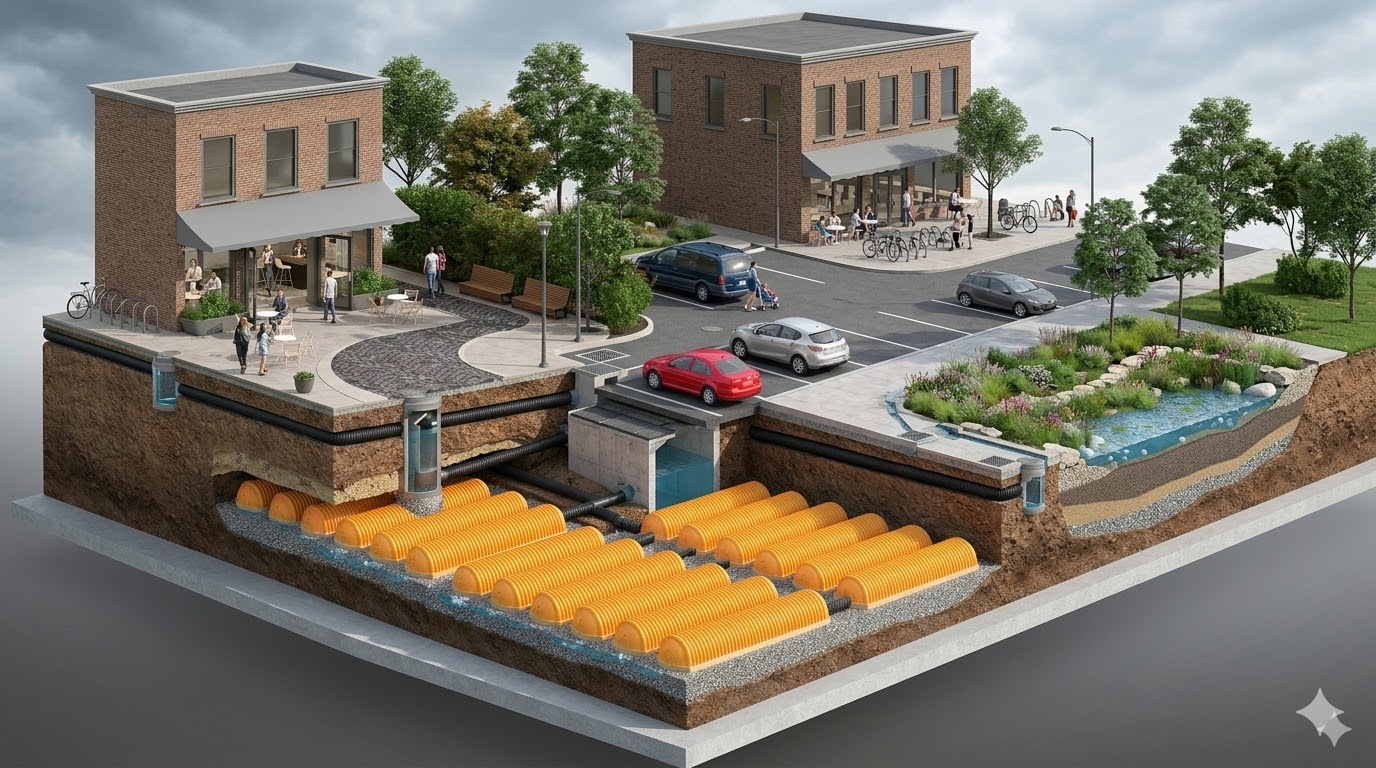
Proprietary manufactured stormwater management systems, underground detention chambers, manufactured treatment units, modular bioretention vaults, and similar products have become a standard part of the commercial site development toolkit. On the right project, in the right location, they are genuinely valuable. They can replace a surface detention pond with an underground system that returns that land to parking or building area, a trade-off that can meaningfully improve project density and operational function.
The problem is that the stormwater product market is active and well-resourced, and vendors do an effective job of positioning their products as solutions to problems that may or may not require them. Developers who have heard about underground detention are sometimes inclined to specify it before anyone has evaluated whether a surface system would satisfy the requirements at a fraction of the cost. And reviewers who are familiar with a particular product occasionally request it by implication, through design standards or preferences that effectively foreclose less expensive conventional alternatives.
The honest evaluation of whether a proprietary system is the right choice for a given project requires understanding what the site’s regulatory obligations are, what the surface alternatives would cost in land area and construction, and what the proprietary system costs in both dollars and long-term maintenance obligations. That is an engineering analysis, not a product selection exercise, and it should drive the decision.
| System Type | When It Makes Sense | When to Reconsider | Fit |
|---|---|---|---|
| Surface Detention Pond | Sites with available open land, lower density requirements, projects over 5 acres where peak rate control dominates the design. Most cost-effective conventional solution. | High-density sites where land is too valuable to dedicate to stormwater. Constrained sites where pond geometry is difficult to achieve. | Best Value |
| Underground Detention Chambers | High-density commercial or industrial sites where surface area is a premium. Infill development where a pond is not feasible. Provides full peak rate control and volume management underground. | Sites where a surface pond fits without sacrificing density. Maintenance access can be challenging and long-term costs are higher than surface systems. | Density Justified |
| Bioretention / Rain Gardens | Excellent for runoff reduction credit and water quality treatment. Can be integrated into landscaping and green space. Reduces the size requirement for downstream detention. | Poor soils or high seasonal water table can limit effectiveness. Maintenance must be planned and budgeted from the start. | Strong Tool |
| Manufactured Treatment Units | Constrained sites where conventional treatment is not feasible. Can substitute for water quality volume requirements in specific circumstances with DEC approval. | Sites where conventional bioretention or a properly sized pond already meets the water quality standard. High unit cost and ongoing maintenance requirements should be weighed carefully. | Use Selectively |
| Permeable Pavement | Effective for runoff reduction credit in parking areas. Can meaningfully reduce required downstream storage volumes and qualify for significant volume credit under the design manual. | High traffic loading or frequent heavy vehicle use can compromise long-term performance. Requires disciplined maintenance to sustain infiltration rates. | Site Dependent |
Every square foot of surface detention pond is a square foot that cannot be a parking space, a building, a loading dock, or a drive aisle. On a constrained commercial site, a half-acre pond can represent a material reduction in leasable square footage or in the number of units that can be developed. The cost of that lost density, expressed in revenue per square foot over the life of the project, often exceeds the premium cost of an underground system by a significant margin. That calculation belongs on the table during the design phase, not after the pond has been sized and the site plan has been submitted.
How We Navigate Stormwater to Protect Your Project
Our advantage in stormwater is not that we design systems that comply with the standard. Every licensed civil engineer can do that. Our advantage is that we understand the standard well enough to design to it precisely, to know where the reviewer’s request exceeds it, and to make that case clearly enough to be persuasive in a planning board meeting or a comment response letter. That combination, technical depth paired with the ability to communicate it effectively in an approval setting, is less common than it should be.
What Stormwater Design Means for Your Footprint and Your Pro Forma
Stormwater is not a soft cost. The decisions made in stormwater design have direct and quantifiable consequences for project economics: how much land is consumed by non-revenue-generating infrastructure, how much the site construction costs, and how much the long-term maintenance obligation will run. On a commercial or industrial project, those numbers are material.
A detention pond sized conservatively, in response to reviewer pressure rather than regulatory requirement, might consume an additional 10,000 square feet of land area beyond what was necessary. On a retail site, that is several parking spaces and potentially a meaningful reduction in the building footprint. On a multi-unit residential site, it may represent one or two units. Those losses do not appear as a line item in the stormwater design budget. They appear as a reduction in project revenue, and they are permanent.
The same logic applies to proprietary systems specified when conventional ones would have been sufficient. A manufactured underground detention system may cost $150,000 to $400,000 or more depending on size and configuration. A properly designed surface pond on the same site might cost $40,000 to $80,000. If the density gain from eliminating the surface pond justifies the premium, the proprietary system is the right answer. If the site has available open land and the density numbers work either way, specifying the proprietary system is a cost the project should not bear.
Getting these decisions right requires an engineer who is thinking about the project economics, not just the hydraulic calculations. We approach stormwater design as an exercise in optimizing the full project outcome: regulatory compliance, construction cost, land efficiency, and long-term operability. Those objectives are not in conflict when the design is done correctly. They are all served by the same principle: design to the standard, and not past it.
Which SPDES requirements apply to this project, and does the municipality have a more stringent local law that adds to them? What are the quantitative, qualitative, and runoff reduction obligations specifically? Where is stormwater management most likely to generate comments in this municipality, and what is our strategy for those comments? Is a surface or underground system more appropriate for this site's density and budget? And what is the cost in land area and construction dollars of the stormwater footprint we are planning?
If your engineer cannot answer those questions before the site plan is drawn, the stormwater design is not being managed. It is being reacted to, and that reaction will happen at your expense during the approval process.
Frequently Asked Questions
Design to the Standard. Not Past It.
Stormwater regulation in New York State is real, technically demanding, and non-negotiable in its core requirements. We are not suggesting that developers look for ways around it. We are suggesting that the distance between the regulatory standard and what projects routinely get designed to, under the pressure of municipal review, is larger than it should be and larger than it needs to be.
The cost of that gap is paid by the developer: in construction dollars, in land area, in approval timeline, and in project density. It is not a regulatory cost. It is an efficiency cost, and it is largely avoidable with the right engineering team and the right approach to the review process.
If you are planning a commercial or industrial project in Western New York, we would welcome a conversation about the stormwater requirements that will apply to your site, how they are likely to affect your design, and what a well-optimized approach looks like before any of that pressure has a chance to drive your design in the wrong direction.
The time to get stormwater right is before the first site plan is drawn.